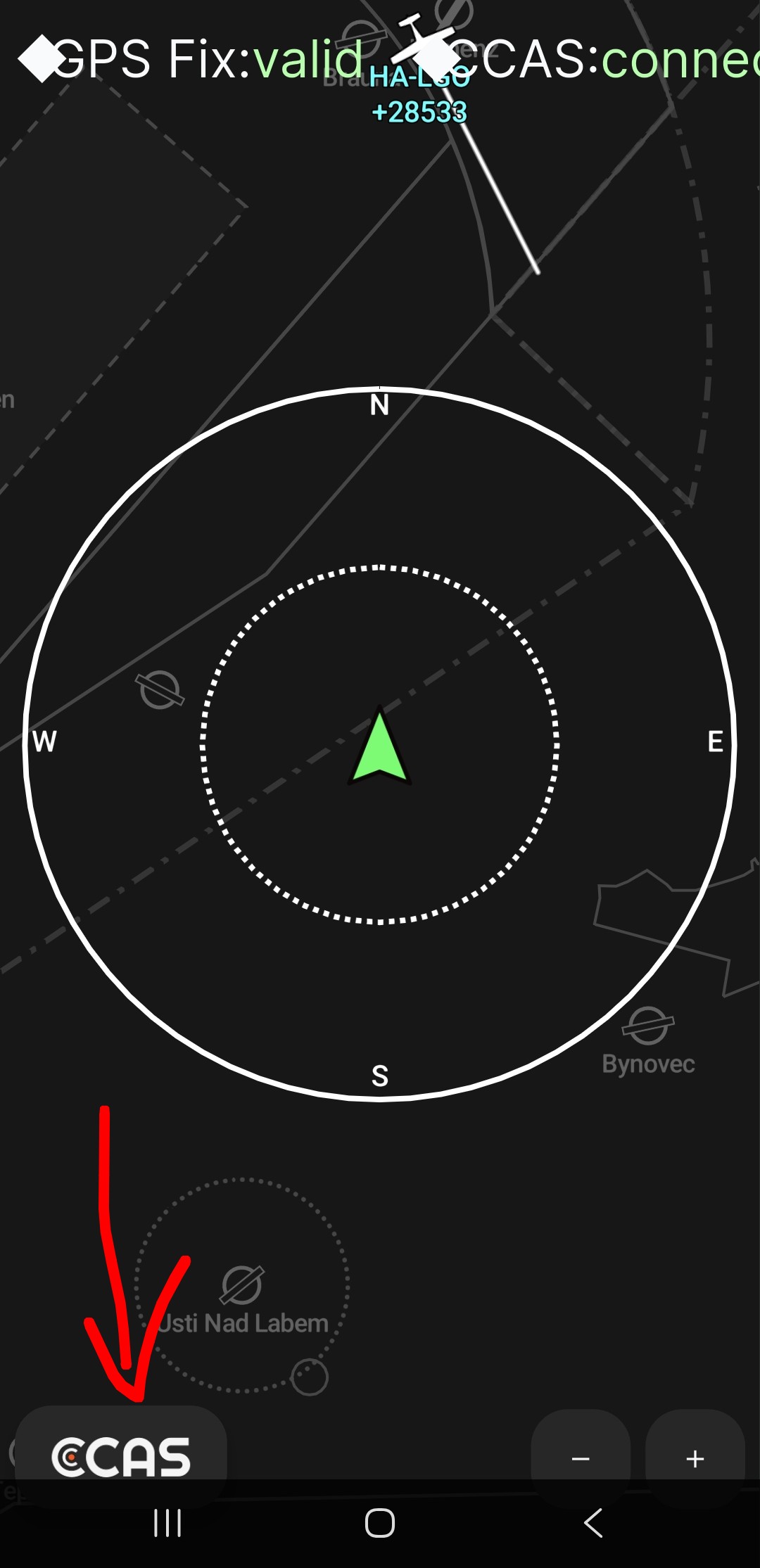
Startux and the CCAS app (thanks for this great app!) both have their advantages.
Does a dual-band connection to VFRnav work if you are connected to the Stratux via Wi‑Fi and are simultaneously running the CCAS app? I’m thinking, for example, of redundancy and barometric altitude which (if fitted) could be queried by the Stratux.
You need internet ( mobile data) on the device ( tablet/phone) for CCAS. As far as I know, a BMP280 from VFRnav is still not being queried. Switching the altitude display to Baro queries a baro sensor in the phone. ( if present)
as far as I know it’s on the to-do list. @Hermann?
Note: My extensive experiments with the Stratux have shown that the installation position in the Stratux is significant for the readings. I also installed a BMP280 in a T-Beam. Above the sensor chip I drilled many 0.8 mm holes to improve the capture of sensor readings. I haven’t yet found a solution I’m very satisfied with.
I am new to the forum and today heard about ccas for the first time — and that’s despite having used VFRnav for many years. So far with Safesky and Stratux.
One question the forum hasn’t yet answered for me, and this post seems to have originally aimed at that question.
My previous configuration (see above) using the free version of Safesky always ran in parallel:
VFRnav with UDP4000 from the Stratux
and
Safesky standalone
So every few minutes I would glance over at Safesky and then back to VFRnav. First of all, big thanks to Hermann for the free integration of ccas into VFRnav.
Can ccas and Stratux run in parallel in VFRnav?
What about duplicate traffic then?
Does ccas use the same sources as Safesky? (i.e., are at least as many targets detected?)
What I noticed on the ground at home on the sofa is that some targets were immediately visible in safesky and not in ccas, but then suddenly after some time still popped up…?!
CCAS can be linked to on-board collision systems (e.g. FLARM or Stratux) via the menu item “External Connection”. This feature is currently still in the testing phase — I therefore welcome your feedback!
Traffic data from FLARM, AT-1, Stratux or other systems are merged with data from the CCAS network and then forwarded to VFRnav.
Does ccas use the same sources as safesky?
CCAS uses the same data. At the same time, we’re currently building an expanded MLAT network.
By the way: someone also asked how duplicate records (identifiers) are handled — would they then be displayed twice? …
In Stratux I can merge known IDs and/or registrations.
Example: on my Stratux units I’ve so far done it so that the T-Beam receives the same hex ID as the Mode S transponder. Otherwise an aircraft (LFZ) would appear twice (and offset). → you can occasionally see this with some planes. (not nice) In the above configuration the aircraft clearly transmits with ADSBOUT/ModeS and “Flarm”/OGN on 868.
MLAT → very good
Note: I’ve also configured an MLAT client on my Stratux units. In the air that only works if mobile internet is available. (so it’s just a gimmick) but it does work.
At the moment it’s as you summarized: when several systems are on board that send or transmit aircraft data, e.g. transponder and Flarm, your aircraft ends up with two internal identifications, which are shown to other participants in the CCAS network as two aircraft.
Ideally this would be automatic detection. That’s my expectation.
Until this is implemented, tested and really works flawlessly, there will be two contacts visible on the map. That’s not pretty — but definitely better than experiments that make it not visible
Hello Hermann, can you please explain to me exactly how to pair CCAS with Stratux?
I tried it via the menu item ‘External Connection’, but no device was shown. Thank you. Best regards, Maik