Hello everyone, until reading this post I didn’t even know that VFRNav can perform a W&B calculation. Now I have entered the center of gravity data of my aircraft into VFRNav according to the VFRNav manual. But it’s not clear to me what VFRNav does with it? Where are the data used? I must have overlooked some function. Could someone please help me?
BTW: Can VFRNav also calculate takeoff/landing distances?
I always create my route via the map and then go to Flight Planning.
There I enter, under “Aircraft”, all load configurations applicable to the flight. From that the Weight&Balance is calculated. That is then also included in the Preflight Bulletin.
That’s how I always do it - maybe there’s another way though
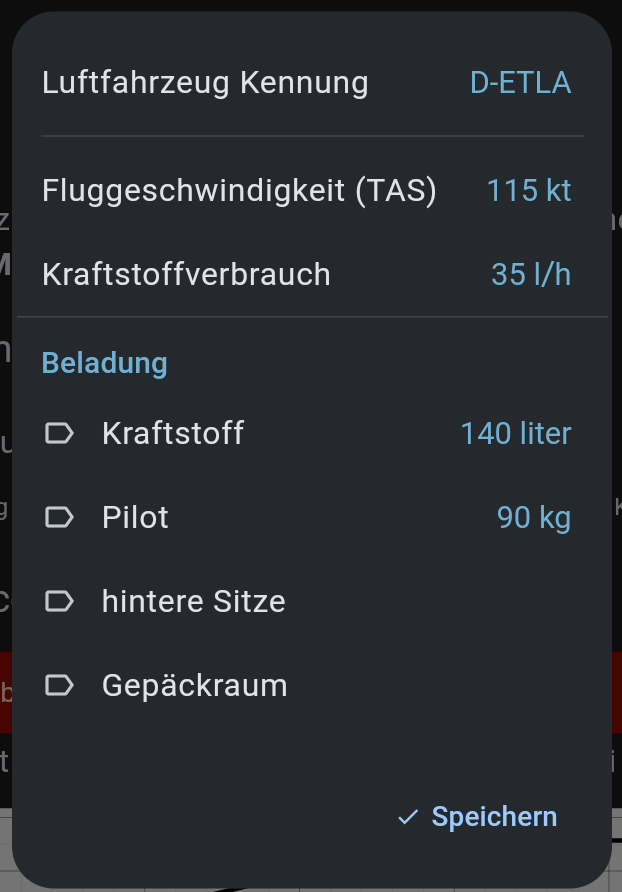
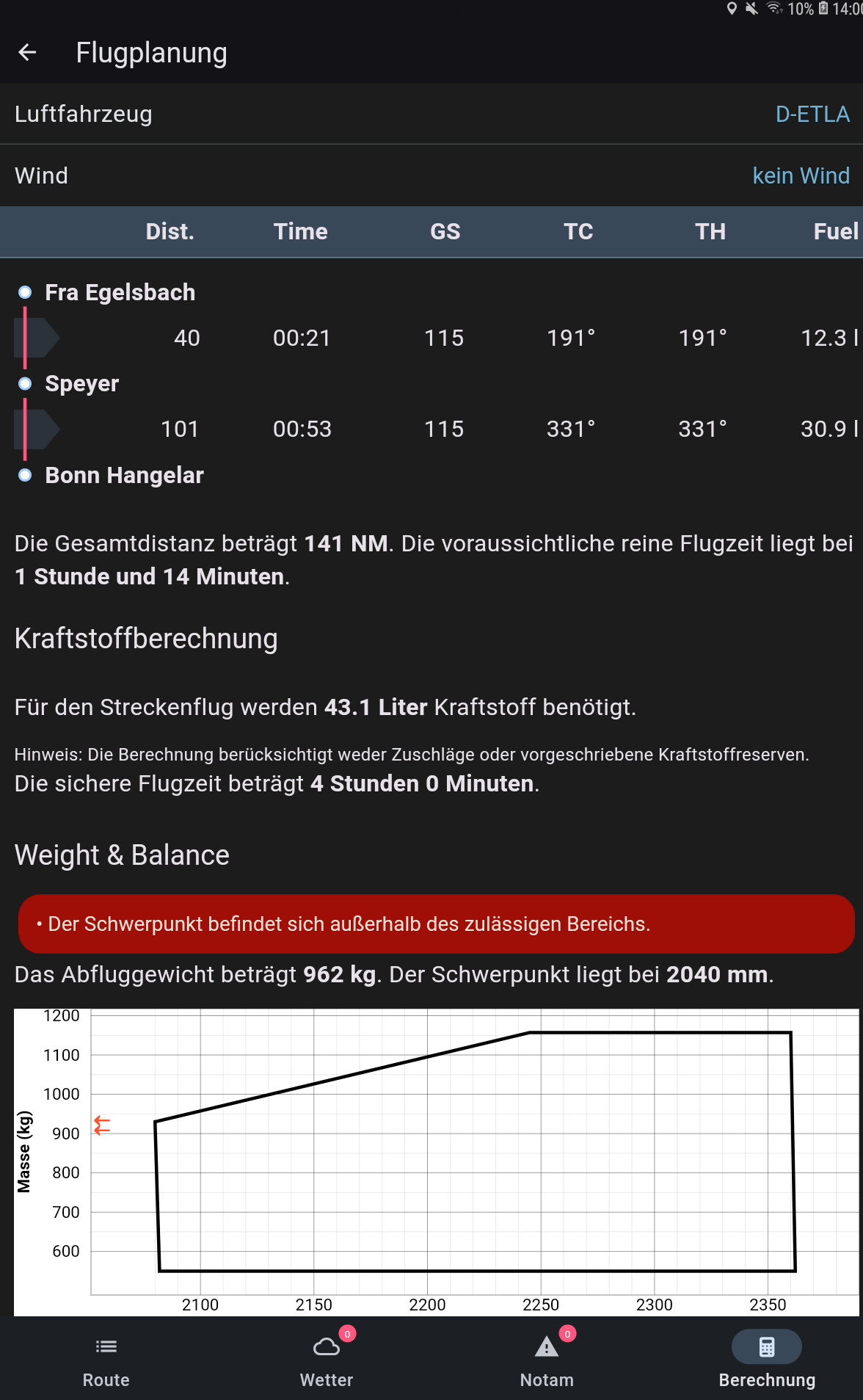
First of all, many thanks for the help. I can now see W&B in the flight planning. However, I must be too stupid to read the W&B parameters correctly from the flight manual, because with a 90 kg pilot and 140 liters of fuel the W&B calculation claims the center of gravity would be outside the limits. That would make the airplane practically unflyable. Does anyone happen to have correct values for a Piper PA-28 on hand? Then I could at least do a plausibility check of my inputs.
Furthermore, I’ve just noticed that entered mass values disappear again after restarting the app.
@H655 , is that intentional? Unfortunately, this means it’s not possible to create a complete flight plan at home and have it available again at the airfield without re-entering the values.
afterwards you define the quantity (l) …and important! which fuel. Because Avgas and Mogas have different weights.
further lever arms such as luggage should be added accordingly in the corresponding LfZ.
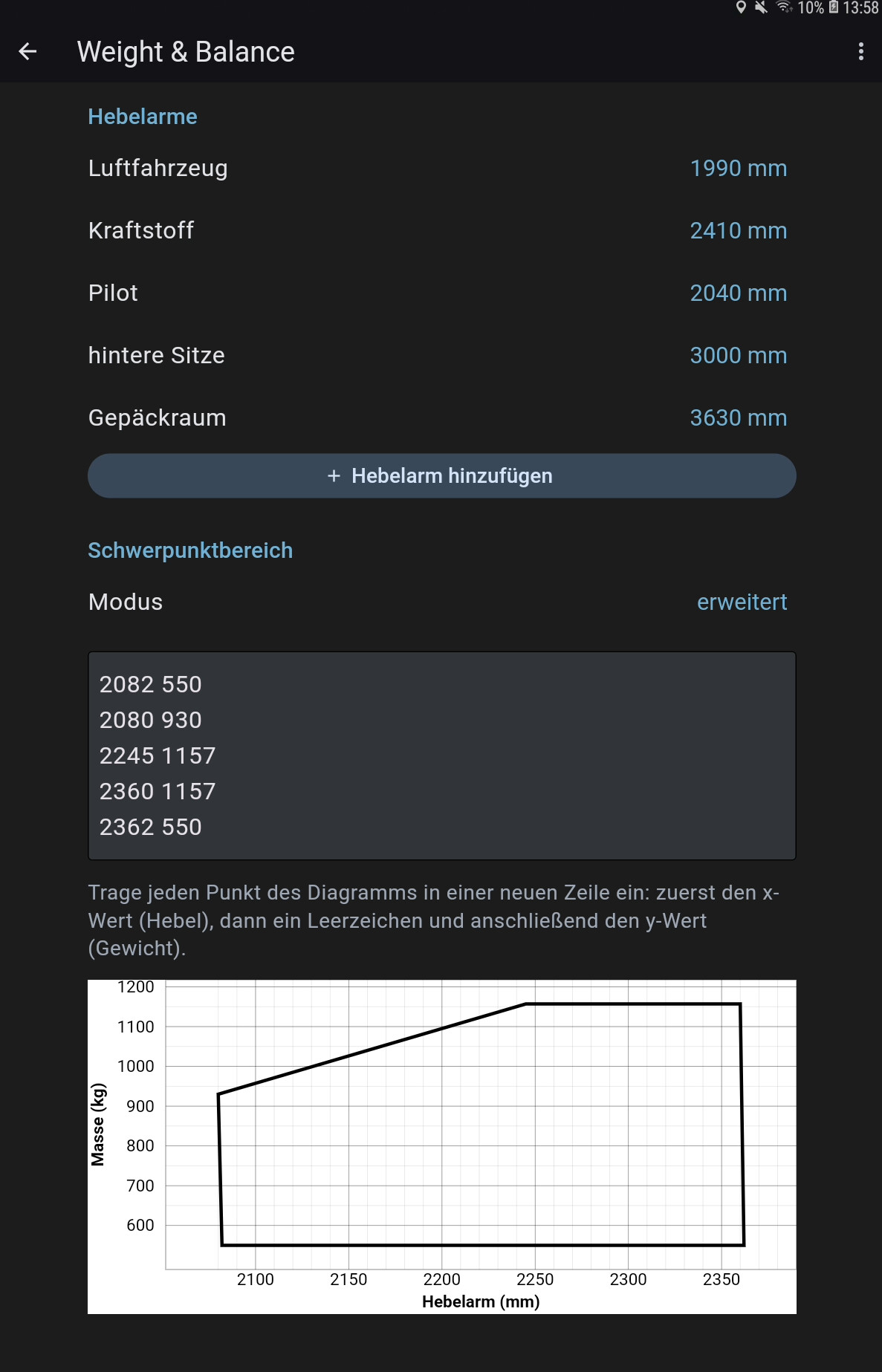
as well the center-of-gravity areas
These are the basic settings for the aircraft.
For each flight plan, however, you must now enter the exact values only for that flight.
This is done by tapping the registration in Base menu → Flight planning → Calculation → Aircraft: → replace the preset values with the current values. When you finish VFRnav, you have reached the destination. After a restart the base values are initially reloaded, yes. If it was only an intermediate waypoint, you can keep VFRnav running and, for the onward flight, if necessary, correct the consumed fuel amount. (if you want it to be completely accurate).
Did the description answer your question, or did you mean something else?
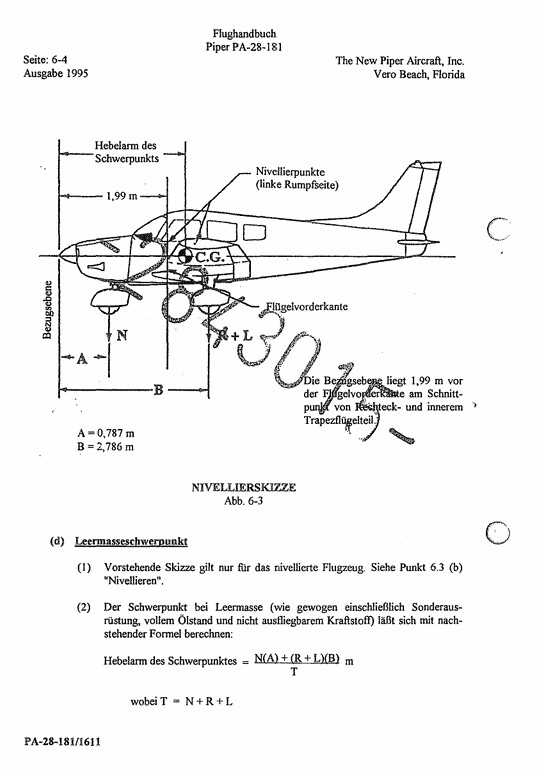
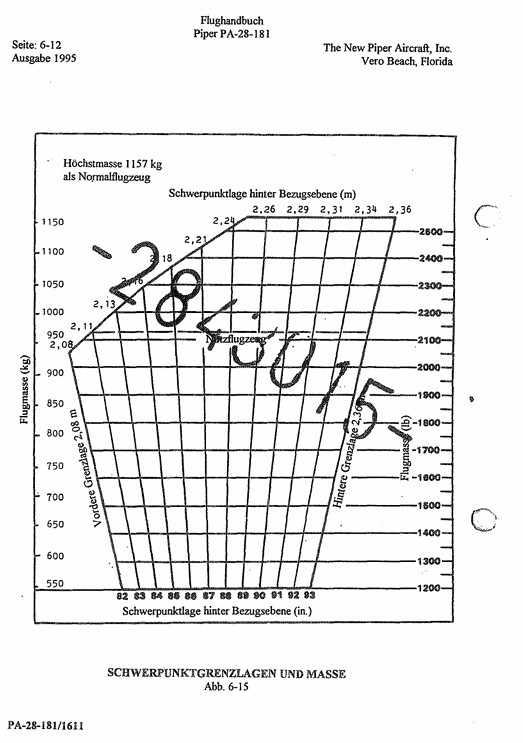
I’ve done it exactly like that now. But apparently the entered base values for a Piper PA28 are not correct, because with a pilot weighing 90 kg and 140 liters of UL91 fuel, the calculation shows the center of gravity is outside the allowable range. If the calculation were correct, that would mean I couldn’t fly the aircraft alone at all, which is definitely not the case. So for now I assume that I extracted the base values incorrectly from the POH.
Why don’t you just post your values or make screenshots of the inputs/calculations? I think that will increase the chances that we can help you find a solution
The value is listed at least on the first page of the Pilot’s Operating Handbook (POH). The empty weight is about 750 kg, if I recall correctly. I’ll post the weighing report tomorrow.
Ok. That could be the error. In the weighing report, under empty weight data, a weight of 767 kg and an arm of 221.18 cm are listed. So I probably have to enter 2212 mm instead of 1990 mm.