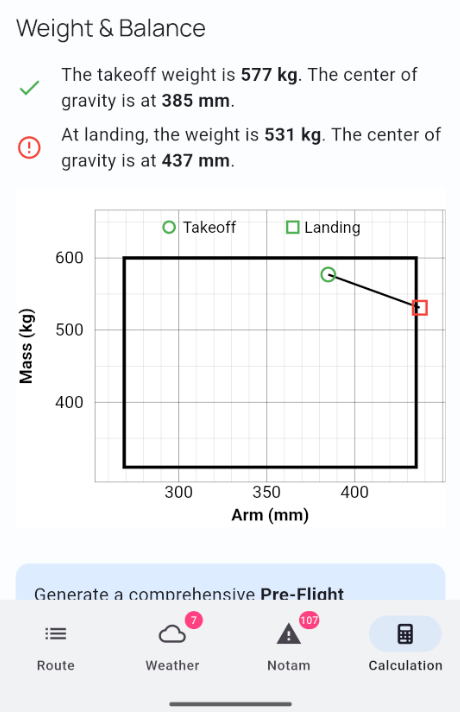
Weight & Balance during takeoff and landing with reduced fuel quantity.
If we look at it very soberly, without all the bogeymen á la “if something happens then it’s on you” and “ohhh, the insurance will be pleased” or “grounded after a ramp check”: When does this really become relevant for us VFR pilots?
Typical charter and club aircraft with wing tanks (near the CG) have virtually no CG shift.
That leaves fuselage tanks as a “little problem”. But here you know after the third W&B calculation that when landing solo you should still have x litres left.
I think in 95% of cases this is (for us) more of an academic issue.
@KaBaPilot This is absolutely not meant as a judgement of your post or you as a person. Just my personal opinion on the topic
At the moment I’m still in testing, but I’m considering purchasing VFRNAV.
To eliminate paper planning, I’m still missing two vital items:
(I fly in a mountainous region with an aircraft type that has a center tank in front of the pilot)
The center of gravity calculation must display the tank fuel level as a straight line on the graph. With baggage, the aircraft could become tail-heavy when the tank is empty.
Takeoff and landing distance depends on density altitude. A calculation of this, including other factors, is important. Tabulated with custom safety margins
Hello and thanks for the feedback. Mine is a BREEZER b400-6. It has a fuel tank in front of the pilot with a negative moment arm. During flight, as the 75 L of Super is consumed, if the large baggage compartment is used a tail-heavy condition could theoretically develop that was not present at takeoff.
Important for density altitude and general takeoff and landing distance calculations: example mountain flying, altiports, warm summer, high in the mountains, limited grass runway, etc…
I can understand @molta’s point of view and largely agree with him. The flight-related effects of a shift in the center of gravity due to fuel burn are rather small for most common VFR aircraft.
Nevertheless, I think: if we’re already performing the calculation anyway, it doesn’t hurt to also take the influence of fuel burn into account.
Here’s a first draft/proposal for a possible presentation:
I wanted to follow up on the point that was raised about calculating takeoff/landing distances. Is such a feature planned or maybe even already in development?
The takeoff and landing distance calculation is still on the development plan. However, priority at the moment is the modernization of the PIB so that the above-mentioned display of the shift in the center of gravity can be integrated.
Based on which parameters would you like to refine the takeoff and landing distances?
Relying on a calculation for that is suicidal. You will never have all the parameters. (VFRnav is not designed to fly Boeings or Airbuses…)
In light aircraft your power must be sufficient for the planned flights; that comes with experience and knowing your power margin. Seeking reassurance through numbers is already an early warning sign of danger.
If software had to calculate my margin based on runway elevation, the day’s pressure and the grass height (and if I couldn’t know that without using software..) I’d stop flying in the mountains. Entrusting your life to software is heresy.
In conclusion this kind of feature is totally useless, in the sense that it doesn’t provide anything that can be taken into account to seriously decide whether to take off or not.
After well over 1,500 flight hours in the Alps — flights in heat, cold, and by the sea…
Such a calculation by software can at best provide an unreliable overview that may even lead beginners to “possibly” make misjudgments. Good flight preparation consists of several components and is not done exclusively with VFRnav or a navigation program.
With slow, step-by-step practice you can best gain experience yourself here.